

 Start AI assessment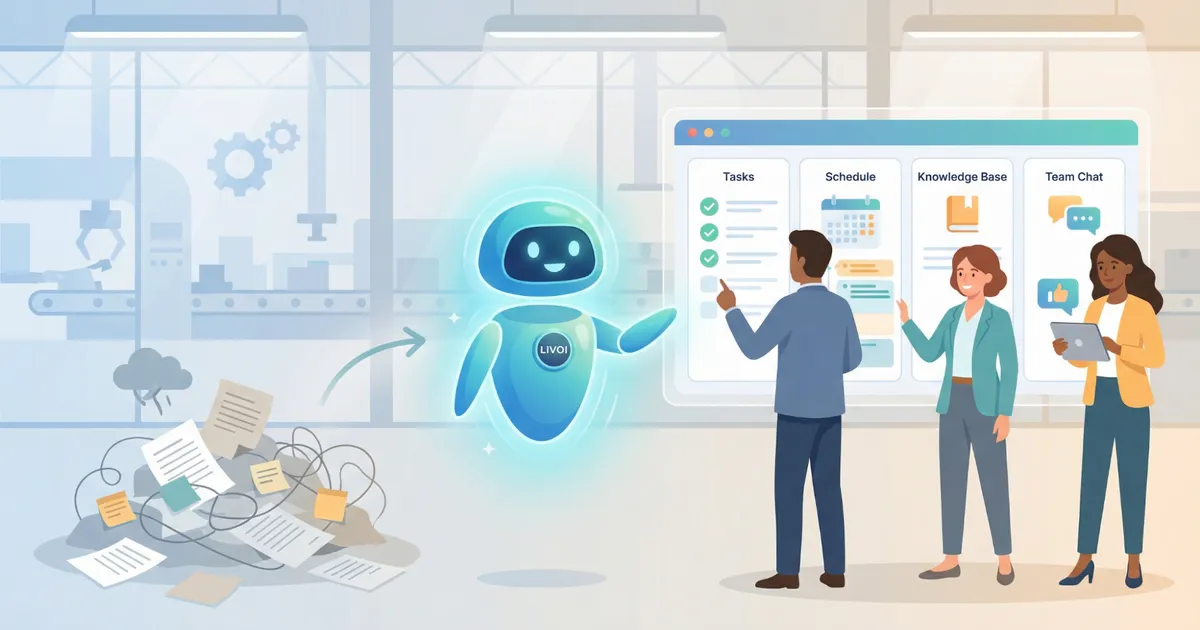
Many mid-market companies are not against AI. They are against effort without results. AI sounds exciting, but getting started feels like a project: unclear, large, risky. That’s exactly why it often stays at “We should really look into that.”
But AI in the mid-market is not a future topic and not a strategy exercise. AI makes sense when it delivers tangible relief.
The Real Pain Points (and Why AI Is Even Relevant)
If you take an honest look, the same time drains appear in almost every company:
- Recurring questions block skilled staff (“What’s the status? Where can I find that? What applies here?”)
- Knowledge is stuck in people’s heads and folders instead of being accessible
- Meetings create work, but to-dos get lost or are duplicated
- Emails, follow-ups, and coordination eat up the day
- Staff absence paralyzes workflows because no one can step in fast enough
This doesn’t just cost time. It costs speed, quality, and often revenue.
The Solution Is Not “Implement AI” but Transform a Routine into Automation
The biggest mistake is treating AI as a major undertaking. The best entry point is small and concrete.
Don’t ask: “How do we implement AI?”
Ask: “Which routine costs us the most time every week?”
Pick exactly one of these three entry categories:
Relieve Communication
Standard responses, follow-up questions, status updates, handovers.
Make Knowledge Accessible
“Where is that documented?” → a reliable answer in seconds.
Make Meetings Actionable
Notes, decisions, to-dos, and follow-ups automatically structured.
What Companies Should Do Now (Without a Major Project)
Step 1: Choose a bottleneck. The point that annoys and slows your team the most.
Step 2: Define a clear outcome. For example: “Answers to standard questions take minutes instead of hours.”
Step 3: Set guardrails. What may the AI use? What requires human approval? Which data is off-limits?
Step 4: Test small and measure only what matters. Does it save time? Are answers faster? Are there fewer follow-up questions?
If yes: expand. If no: switch use case.
This is how successful AI projects start in the mid-market: small, controlled, measurable.
If You Want to Start Pragmatically: LIVOI
If you want to start with small, concretely measurable steps that demonstrate visible resource savings from the very beginning, our recommendation is LIVOI.
If you want to use AI in the mid-market pragmatically, without tool sprawl and without internal DIY projects, LIVOI is built exactly for that: the AI assistant for the mid-market that handles communication, makes company knowledge usable, and relieves teams.
LIVOI is implemented as a ready-to-use package for a clear area of deployment, with defined rules and handovers, so it is cleanly anchored within the organization.
In daily work, it runs where employees actually work: for example via WhatsApp and Microsoft Teams, including features like document handling and access control.
And because the mid-market works with responsibility, not “AI hype”: LIVOI is designed for GDPR-oriented operation (including hosting in Germany, no model training with customer data; raw data stays in Germany, external AI services only receive prepared chunks).
LIVOI guides you through a few questions in a short conversation and then shows you the best starting point where your money could be saved.
If instead of “saving time” the request goes more toward “rocket to the moon,” LIVOI brings in a human expert and stays true to its principle: no sales pitch, just honest feedback.