

Models and context
Instructions, conversation history and attachments provide context for the selected model. The platform brings model requests and tool results together in the conversation.
Connect models, knowledge and tools in LIVOI.
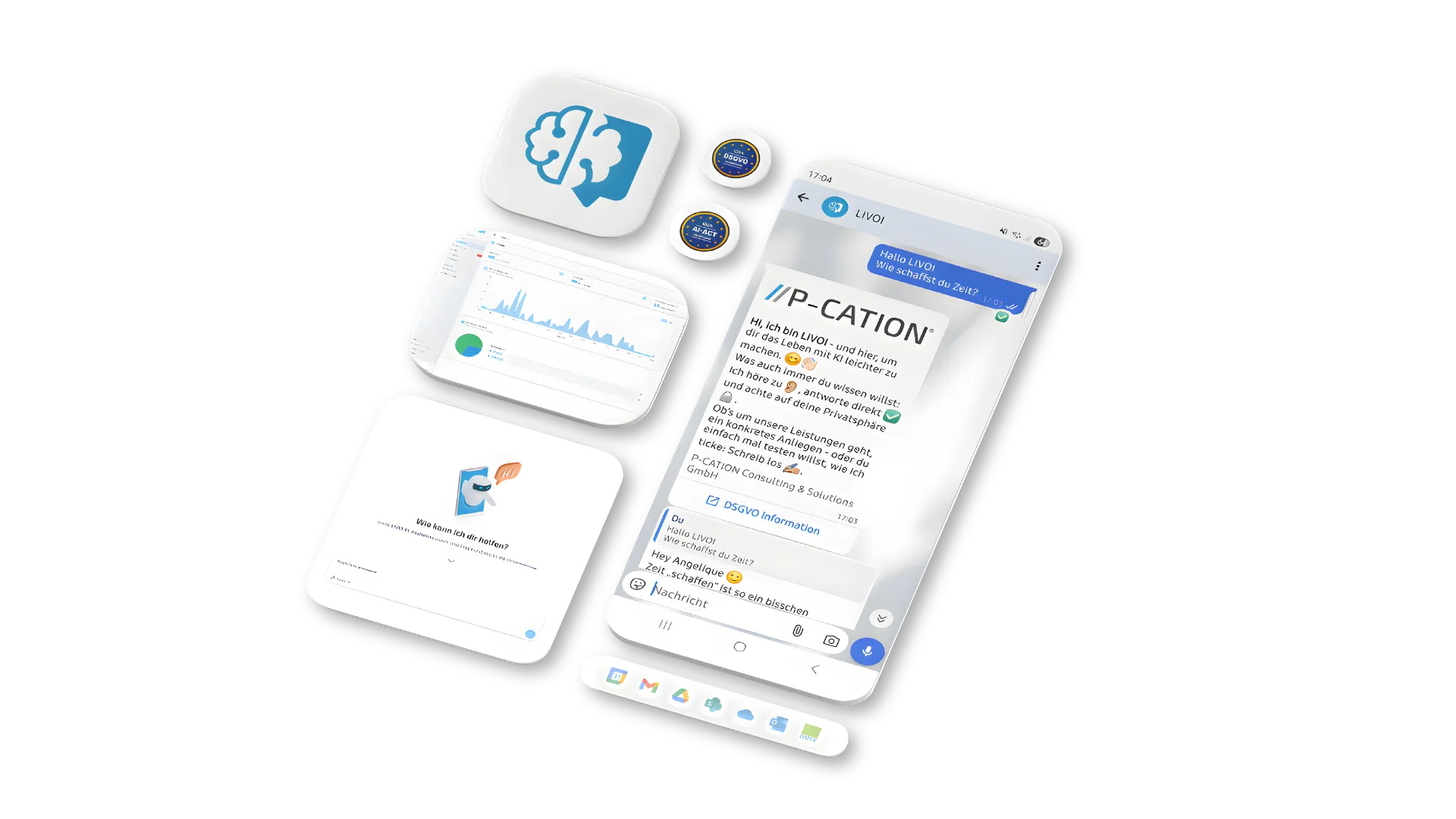
LIVOI is an agent harness: the software around the AI model. The platform provides context, executes tool calls and manages conversations and access. P-CATION helps you configure it and connect it to your systems.
For each agent, you configure the model, instructions, knowledge sources and available tools. LIVOI coordinates their execution.
Instructions, conversation history and attachments provide context for the selected model. The platform brings model requests and tool results together in the conversation.
Documents are prepared for knowledge retrieval. Retrieval-augmented generation (RAG) gives the agent relevant content and sources from the available knowledge base.
LIVOI tools provide capabilities such as knowledge retrieval. Custom tools call your own HTTP APIs. MCP clients connect agents to tools offered by configured MCP servers.
Agents can be used in the dashboard, through the API and via connected channels such as WhatsApp. Their tasks depend on the sources, tools and configuration.
Employees ask about processes, product data or instructions. The agent searches the knowledge sources available to it.
View example (German)Use manuals and documents as the basis for answers and work instructions. Define subject boundaries and follow-up questions in the agent instructions.
View example (German)Gather requirements in conversation, provide information from product documentation and prepare a subsequent consultation.
View example (German)We define the use case, prepare knowledge sources and configure agents and permissions. Where needed, we develop custom tools and interfaces. Before rollout, we check agent behavior against concrete test cases.
The LIVOI application, background processing and central data stores run in a German data center. Stored data includes original files, chat attachments, conversation history, prepared text, metadata and embeddings.
View data flows and locations (German)Encryption protects data in transit and sensitive credentials. Permissions determine who can use which content. These safeguards work together at different levels.
Data between your browser and LIVOI is encrypted in transit. This protects messages and login data against interception on the network.
The dashboard and API are available over HTTPS and support TLS 1.2 and TLS 1.3. TLS encrypts the connection and verifies the server identity using a certificate. To handle a request, LIVOI processes its content in plaintext; configured AI services receive the content sent to them for their task.
Sensitive credentials for connected services are encrypted in designated database fields. These include model API keys, OAuth tokens and MCP credentials.
LIVOI uses PostgreSQL pgcrypto with AES-256 for these fields. Encryption and decryption happen at field level. The required key is supplied through the operating environment. The application decrypts values when it needs them for an authorized integration. This additional field encryption applies to the designated credential fields.
A tenant is a separate workspace for an organization. Within it, roles and groups define who may read or edit data and configure agents.
LIVOI combines role-based access control (RBAC) with row-level security (RLS) in PostgreSQL. Application database access is restricted according to the tenant, user and permission context. Resource grants allow targeted access to individual items.
For certain file operations, LIVOI creates signed links with an expiry time. Authorized workflows can retrieve files without requiring a permanently valid download link.
Presigned URLs sign a specific file operation and limit its validity. The lifetime depends on the individual request. Anyone holding the link can use it while it is valid. Expiration does not delete content that has already been downloaded.
LIVOI checks its own API keys against a stored verification value. For connected WhatsApp webhooks, it also checks that the message carries a valid signature.
To verify its own API keys, LIVOI stores an HMAC-SHA-256 value calculated with an individual salt. WhatsApp webhook signature verification also uses HMAC-SHA-256. Hashes and signatures verify secrets or message authenticity and integrity; they do not encrypt message content.
Details of additional storage layers, backups, retention and organizational safeguards are established for the specific operating environment. Technical and organizational measures (TOMs) and contractual documents are available on request.
Storage in Germany does not mean all processing takes place there. Depending on the feature, content is sent to configured services.
Permissions are evaluated within each tenant. Roles bundle permitted actions; groups help assign them to multiple users. Depending on the resource, access can be limited to owned, shared or tenant-wide content.
You define who can configure agents, maintain knowledge and use resources. Permissions in external APIs and MCP servers are also governed by the respective integration.
Privacy policy, terms, and AVV/DPA are currently provided on request.
An agent harness is the software around an AI model. LIVOI assembles context, executes tool calls and manages conversations and permissions. Models, knowledge and tools are configured per agent.
Custom tools call configured HTTP APIs. MCP clients expose tools from connected MCP servers. The LIVOI API also lets you embed agents into your applications. P-CATION helps implement the appropriate integration.
The dashboard and API use HTTPS with TLS, supporting TLS 1.2 and TLS 1.3. Sensitive credentials such as model API keys, OAuth tokens and MCP credentials are encrypted in designated database fields using AES-256 through PostgreSQL pgcrypto. Further storage and backup details depend on the operating environment and are addressed in its technical and organizational measures.
The central data stores of the LIVOI environment are in a German data center. AI requests, knowledge preparation, tool calls and external communication channels may send content to other services. Their processing locations must be considered separately.
Processing region, retention and possible provider use of content depend on the selected service, its configuration and agreed terms. These points are established for the specific integration.