

P-CATION Logo
Back to blog

Time tracking should not feel like work – why we are building a digital time clock

Why time tracking inside ERP systems often fails and how a lightweight digital time clock with AI support turns time booking into a background process.

Published:

Updated:

Author: P-CATION Redaktion

Digitalization Digitalization Process optimization AI consulting

The checkout counter problem

Imagine you go grocery shopping. Items in the cart, head to the register, pay, done. The receipt prints automatically – without the cashier thinking about it for even a second.

Now imagine the cashier had to create the ledger by hand every time. Writing down each item: product name, weight, quantity, price, VAT. For every single customer. All day long. Sounds absurd?

That is exactly how time tracking works in many companies. And just like the receipt should come out of the register automatically, time tracking should happen in the background – no extra effort, no forms, no thinking required.

Why existing systems often fail

We have seen the same pattern over and over in practice: companies use an inventory management system, an ERP, or a billing solution – and somewhere inside it there is a time tracking module. In theory. In practice it means:

  • Nested menus and clunky input forms
  • Mandatory fields nobody understands
  • A frantic catch-up booking session at the end of every month

The problem is not the software itself. The problem is that time tracking is a byproduct there – embedded in a system built for entirely different tasks. The result: employees perceive booking as an additional chore. A tedious duty that distracts from their actual job.

And that is exactly where the misconception lies.

Booking must not be a task

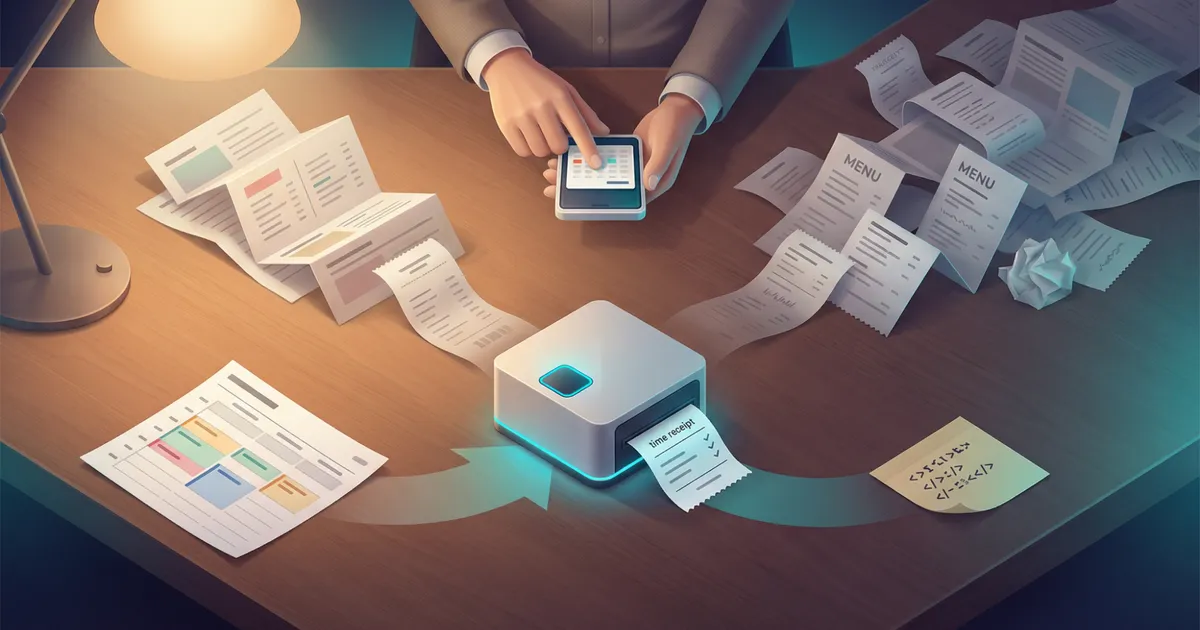
Our approach flips the perspective: time tracking should not be a separate work step. It should happen as naturally as the beep at the supermarket checkout. In the background. Without extra effort. Without the thought “Oh, I still need to log my hours.”

That is why we asked ourselves: what if there were a lean, standalone tool that does exactly one thing really well – track time? Simple. Intuitive. And independent of whichever primary system runs in the background.

A time clock for the modern workplace

What emerged is a digital time clock that bridges two worlds:

  • Contractual working time – the classic clock-in and clock-out. Start a shift, take a break, call it a day. With a click in the browser, an NFC tag at your desk, or on the go with your phone. Whether you are in the office or working from home.
  • Project-based working time – the allocation: what did I work on today? Internal project or client order? Which line item? Via a running timer that tracks in the background and gets assigned with two clicks at the end.

The key point: both happen in the same interface.

  • No system switching
  • No second login
  • No duplicate data entry

AI as a silent helper

But even two clicks are sometimes two too many – especially when your mind is elsewhere. That is why we use AI-powered assistance for booking. The system learns from context:

  • Which projects are currently active?
  • What was booked last?
  • Which category is the most likely match?

The goal is not to replace people. It is to take the mental load of choosing the right allocation off their plate. So that booking actually happens in the background – not as a conscious decision, but as a natural part of the workflow. How radically AI’s role in software development is changing right now is also shown by the concept of Agentic Engineering – an approach where AI agents don’t just assist, but autonomously orchestrate entire workflows.

The primary system stays where it is

And here is the key: booked hours do not disappear into a silo. Through integrations they flow where they belong:

  • Into the ERP system
  • Into inventory management
  • To DATEV
  • Into payroll

The primary system remains the single source of truth for billing. Our solution is the fast, frictionless input channel in front of it.

Think of it as a preliminary stage: instead of forcing employees into a complex billing system, we give them a tool tailored to their daily reality. And in the background, the integration ensures data arrives where accounting needs it.

What we solve with this

Ultimately it comes down to a single question: how do we make sure time tracking is not perceived as a burden?

The answer is not a new feature in an existing system. The answer is a standalone tool so simple that it disappears. One you use without thinking about it. One that feels like – yes, like the scanner at the checkout.

Because the best time tracking is the kind you do not even notice.

Curious?

Want to see what time tracking feels like when it does not feel like work? We would love to show you the product in a short demo – or you can test it yourself right away. Just get in touch, we look forward to the conversation.