

 Start AI assessment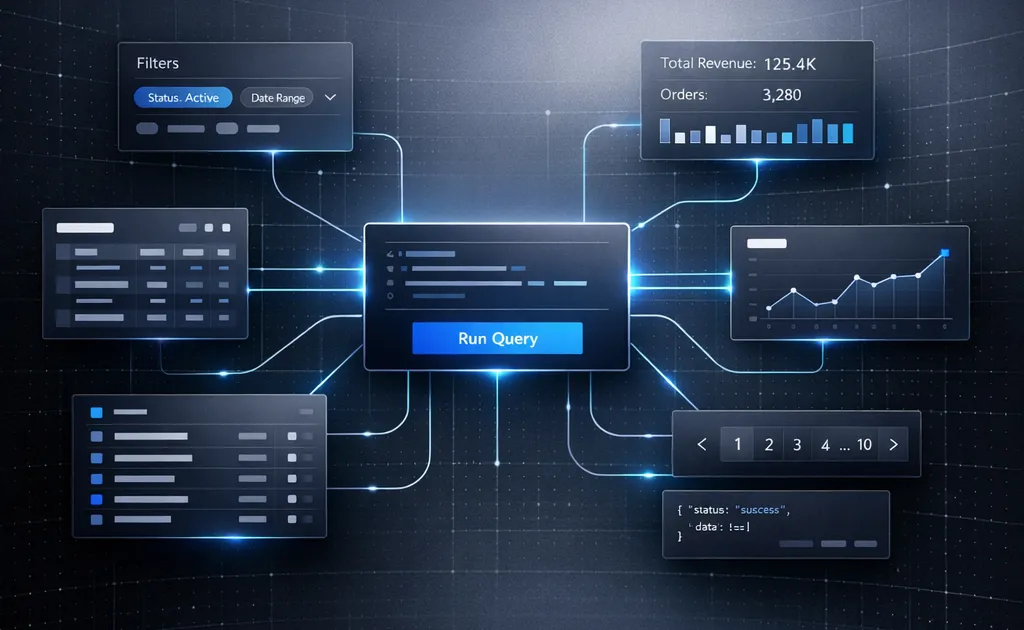
In our last article, Why LIVOI is built API-first, we talked about a simple but fundamental idea: APIs should not be an afterthought. They need to be the foundation of your product.
But “API-first” is an easy buzzword to throw around. What actually matters is what that architecture enables in the real world. This is where things get interesting, and where most standard API designs start to break down.
The problem we kept running into
If you have built anything beyond a simple prototype, you know exactly how this goes. You start with a few clean endpoints: GET /users, GET /orders, maybe a basic status filter. Everything works perfectly.
Until it doesn’t.
Because as soon as real users hit your product, the feature requests start rolling in:
- “Can we add a filter for date ranges?”
- “Can we include the user’s last three orders in this view to save a request?”
- “We need a completely different data slice for the new admin dashboard.”
Suddenly, you are not building a product anymore. You are building an endpoint factory. Every new frontend requirement means a backend ticket, a database query update, and a new deployment.
The API becomes the bottleneck.
So we stopped building endpoints
Instead of piling on more and more specialized endpoints, we asked a different question: What if the client could simply ask for exactly what it needs?
Not in a theoretical, highly abstracted way. In a way that actually works and scales in production.
That question led us to build one of the core features of LIVOI: POST /dynamic/query.
Instead of an explosion of API variants, we built one unified endpoint. With Dynamic Queries, the client defines what data it needs, how it should be filtered, and how it should be structured. The API simply executes it.
No negotiation between frontend and backend. No waiting for the next sprint to add a new filter.
How this changes the way you build
This is not just a minor developer convenience. It fundamentally changes how your product evolves.
1. You move faster
When UI requirements change, you do not touch the backend. You adjust the JSON query on the client side. Frontend developers stay unblocked.
2. Your UI stops being constrained
Complex interfaces like dashboards, admin panels, and internal tools are never truly finished. Dynamic queries allow these views to evolve without friction, pulling exactly the data they need when they need it.
3. Your backend gets simpler
You no longer have to maintain dozens of bespoke endpoints, duplicate validation logic, or write custom edge-case handling for every new view. You maintain one system and one secure pattern.
4. You do not pay for flexibility with performance
Flexibility is useless if it chokes your database. We built this engine from day one to handle large datasets, efficient pagination, and real-world query patterns without compromising speed.
”Isn’t this just GraphQL?”
It is a fair question. At a high level, both pursue the same goal: giving the client more control over data access. But we deliberately chose not to go the GraphQL route. Here is why:
- No new language to learn: GraphQL introduces its own query syntax, custom tooling, and a heavier mental model. We did not want that friction. For LIVOI, standard JSON is enough.
- No parallel abstraction layers: GraphQL requires schemas, resolvers, and a dedicated middle layer that constantly needs maintenance. With LIVOI, your data model is your query layer.
- Built for dynamic filtering: GraphQL shines when you know exactly what shape of data you want. It struggles more when you need highly dynamic, deeply nested filters and changing conditions. Real products need exploratory queries, and that is exactly what our dynamic engine is built for.
- Fewer moving parts: GraphQL setups tend to spread logic across multiple files and layers. We wanted the opposite: one system with predictable, transparent behavior.
When this makes sense
Dynamic queries are the right choice when your product evolves quickly, your data access requirements are not fixed, and flexibility is a core requirement rather than an edge case.
If you are building an analytics platform, a highly customized internal tool, or an AI agent that needs flexible access to structured data, this approach feels like a superpower. If you have a completely static site with a tiny, unchanging API surface, standard REST is still fine. That is okay too.
The bottom line
Dynamic Queries are a direct result of how we think about product architecture at LIVOI. An API should not be a rigid, fragile contract that holds you back. It should be an engine that adapts to your product’s growth.
It shifts control away from rigid backend definitions and puts it directly into the hands of the developers building the user experience. Once you build products this way, it is incredibly hard to go back.
Read the deep dive in the LIVOI Dynamic Query docs.