

 Start AI assessment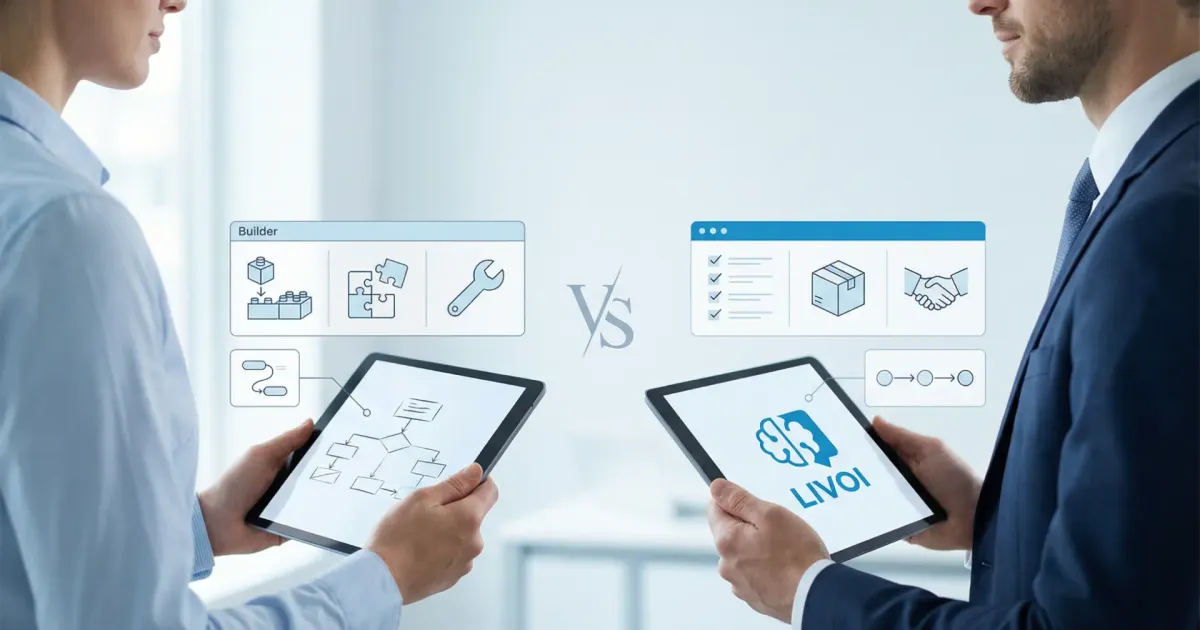
In conversations with companies, the same question keeps coming up more frequently: Is Microsoft Agent Builder enough — or is a specialized solution like LIVOI the better option?
The answer depends less on individual features and more on:
- where the agent will be deployed,
- which data it may use,
- and how important data privacy, control, and process integration are.
This article puts both approaches in context and helps with the decision.
TL;DR
Microsoft Agent Builder is a strong toolkit for first agent scenarios inside the Microsoft ecosystem. LIVOI is the better fit when a company wants a ready-to-run solution for concrete communication workflows, company knowledge, and clear governance.
- Microsoft Agent Builder is strong when teams want to build and experiment themselves.
- LIVOI is strong when one clear use case needs to go productive quickly.
- Privacy, hosting model, and operating rules matter more as soon as the agent moves closer to real customer or employee communication.
- The better choice depends less on the word “agent” and more on the desired operating model.
What Is Microsoft Agent Builder?
Microsoft Agent Builder is a feature that lets you create your own AI agents to support tasks and provide information. The focus is on quickly and flexibly building custom agents, usually within existing Microsoft environments.
It is particularly suitable when:
- Companies want to get started quickly,
- the agent operates within a clearly defined scope,
- and initial agent scenarios need to be tested.
For many mid-market companies, this is a practical entry point to gain experience with AI agents and implement simple use cases.
What Is LIVOI?
LIVOI is a company-specific AI communication assistant developed specifically for typical mid-market use cases. The focus is on areas where communication costs time or leads can be lost, for example:
- Initial contact,
- Customer and prospect inquiries,
- Appointment processes,
- Onboarding,
- Or recurring internal questions.
A key difference lies less in the term “agent” and more in the delivery model.
LIVOI is implemented as a ready-to-use package. The agent is built for a specific area and a clearly defined use case and delivered so that no additional development or setup work is required within the company.
Customers receive a complete setup from P-CATION that:
- Is tailored to the desired area of deployment,
- Contains defined rules and handovers,
- And is organizationally embedded.
Additionally:
- LIVOI is operated in Germany,
- Processes data in a GDPR-compliant manner,
- Runs in a separate, protected environment,
- And specifically uses your company knowledge instead of generating generic answers.
If you want the product and security model in more detail, our LIVOI page provides the central overview of use cases, privacy posture, and rollout model.
Decision Guide: 5 Questions for Orientation
The following questions help determine the right direction:
- Should the agent be used in customer communication, for example for initial contact, inquiries, or qualification?
- Should the AI consistently answer from your company knowledge rather than formulating generically?
- Are requirements like hosting in Germany and GDPR-compliant operation important to you?
- Do you need clear rules, defined handovers, and traceable communication?
- Should the agent cover specific scenarios — such as appointment booking, onboarding, or sales support — and be delivered as a ready-to-use package?
If you’re looking for a directly deployable solution rather than a builder toolkit, LIVOI is the right direction. LIVOI is custom-built for a specific area and use case and delivered as a complete package, so your team doesn’t need to take on any additional development or setup work.
FAQ on Microsoft Agent Builder vs. LIVOI
When is Microsoft Agent Builder enough?
It is enough when a company wants to test first agent scenarios quickly inside Microsoft, and the internal team is willing to own setup, rules, and ongoing evolution.
When is LIVOI the better choice?
When one concrete communication or knowledge workflow should go live quickly, with clear handovers, controlled data access, and as little additional setup work as possible inside the company.
Is this mainly a feature comparison?
No. The decisive factors are operating model, ownership, knowledge sources, privacy requirements, and how deeply the agent will be embedded into real business workflows.
When LIVOI is not the right choice
If your primary goal is to experiment broadly with many variants in a generic builder environment and you want to own the full build layer internally, a specialized package is probably not the right first step.
Conclusion
Microsoft Agent Builder is a good option for creating your own AI agents and implementing initial scenarios within a clearly defined scope.
LIVOI is an option for companies looking for AI assistance for concrete mid-market use cases — custom-implemented, organizationally embedded, and ready to use. Depending on requirements, including GDPR-compliant operation and hosting in Germany.
If you’re currently considering where to start, a quick use-case check is worthwhile: Which one or two scenarios would deliver measurable relief within 30 days? That’s what the decision should be based on.