

 Start AI assessment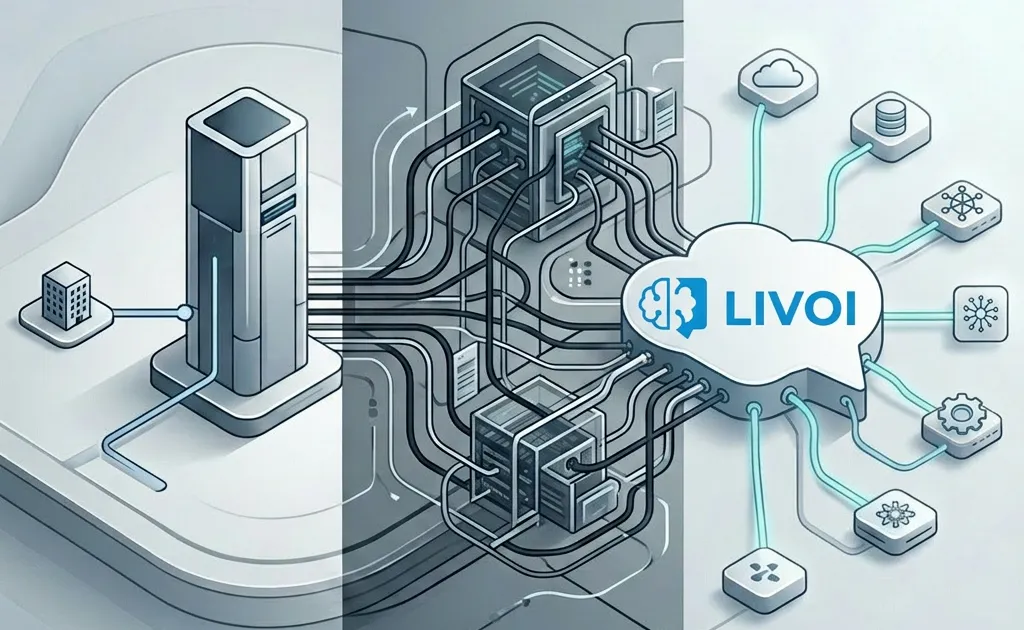
Many companies start their AI journey with a well-known provider. That is understandable. Initial tests move quickly, the barrier to entry is low, and at first glance it seems efficient to build everything inside a single ecosystem.
The problem usually appears later.
As soon as AI is no longer just being tested but integrated into processes, applications, or internal workflows, a new dependency emerges. At that point, it is no longer only about one model. It is about interfaces, hosting, pricing logic, data flows, availability, and how easily a decision can still be corrected later.
That is exactly why we developed LIVOI as an open AI platform.
Why Vendor Lock-In Becomes a Problem in AI
LIVOI is model-agnostic. That means we can connect different inference hosts and model providers as long as they support the OpenAI Responses API specification. Concrete European examples with officially documented Responses API support currently include Scaleway and OVHcloud AI Endpoints. Other European providers such as IONOS or Exoscale offer OpenAI-compatible inference APIs, but their exact Responses API coverage should be checked separately for each product. For companies, that means one thing above all: the platform is not tied to a single American corporation. Not to OpenAI. Not to Microsoft. Not to Google.
Why does that matter?
Because technological dependency in AI can become expensive very quickly. If you tightly couple your solution to one provider from day one, you often absorb that provider’s conditions without even noticing:
- which models are available
- how pricing evolves
- where data is processed
- which infrastructure is imposed
- how flexible future integrations will still be
When requirements change, things become costly. Processes need to be adjusted, integrations rebuilt, or entire parts of the solution rethought. That is exactly what many companies want to avoid, and rightly so.
Why LIVOI Is Built Openly
With LIVOI, we create a different starting point.
The platform is built so that the provider does not dictate the architecture. The use case does. If one model is better suited for internal knowledge work, that model can be used. If another provider is a better fit for data privacy, hosting, or performance, that provider can be connected as well. If the market changes, the platform remains adaptable.
That is not a technical gimmick. It is a strategic decision.
Any company that wants to use AI seriously needs more than fast access to a language model. It needs a platform that can grow with its own requirements. A platform that does not block existing systems. And a platform that prevents future decisions from depending on a single corporation.
Why We Deliberately Use the Responses API Specification
We intentionally use the OpenAI API specification as a shared interface layer. At first glance, that may sound contradictory, but it is not. We are not using the proprietary overall ecosystem of a single provider. We are using a broadly supported API specification that enables interoperability.
That difference matters: we align with an open technical standard for connectivity, not with a closed vendor logic.
In this context, Open Responses is also relevant. The initiative aims to further develop the Responses API as an open standard. That directly supports the path we are taking with LIVOI: not dependency, but compatibility. Not commitment to one corporation, but technical flexibility.
What Companies Gain in Practice
For our customers, this creates tangible advantages.
They can build AI solutions without committing early to a single provider. They retain more control over technical and economic decisions. And they create a foundation on which new models or hosting options can be integrated without having to start from scratch each time.
That is especially important in companies, because the question is rarely only what works today. The real question is what will still be viable tomorrow.
Maybe a US provider is a good fit today. Tomorrow, new data protection rules may apply. Or a European hoster may become more relevant. Or a specialized model may deliver significantly better results for a specific process. If the platform is built openly, those options remain available. If it is built as a closed system, every change becomes a project.
LIVOI is therefore not just access to generative AI. LIVOI is the technical foundation for AI usage that stays controllable.
Companies can align their AI strategy with their own goals:
- compliance requirements
- existing infrastructure
- budget constraints
- concrete use cases
- the question of where control must remain in-house
That was exactly the decisive point for us as developers. We did not want to build a platform that pushes customers into a new dependency. We wanted to build a platform that gives companies more freedom in implementation.
Conclusion
LIVOI stands for an AI architecture that is designed to stay open.
Open to different models. Open to different hosters. Open to new developments in the market. And open to companies that want to use AI without giving up their technological sovereignty.
If you invest in AI today, you should not only ask which model is currently the most well known. The more important question is this: how do we prevent a good first solution from turning into a long-term dependency later?
That is exactly why we developed LIVOI.
Do you want to use AI without locking yourself into a new technology dependency too early? Then let us look together at which architecture fits your requirements: open, adaptable, and aligned with data privacy, hosting, integrations, and long-term freedom of choice.