

 Start AI assessment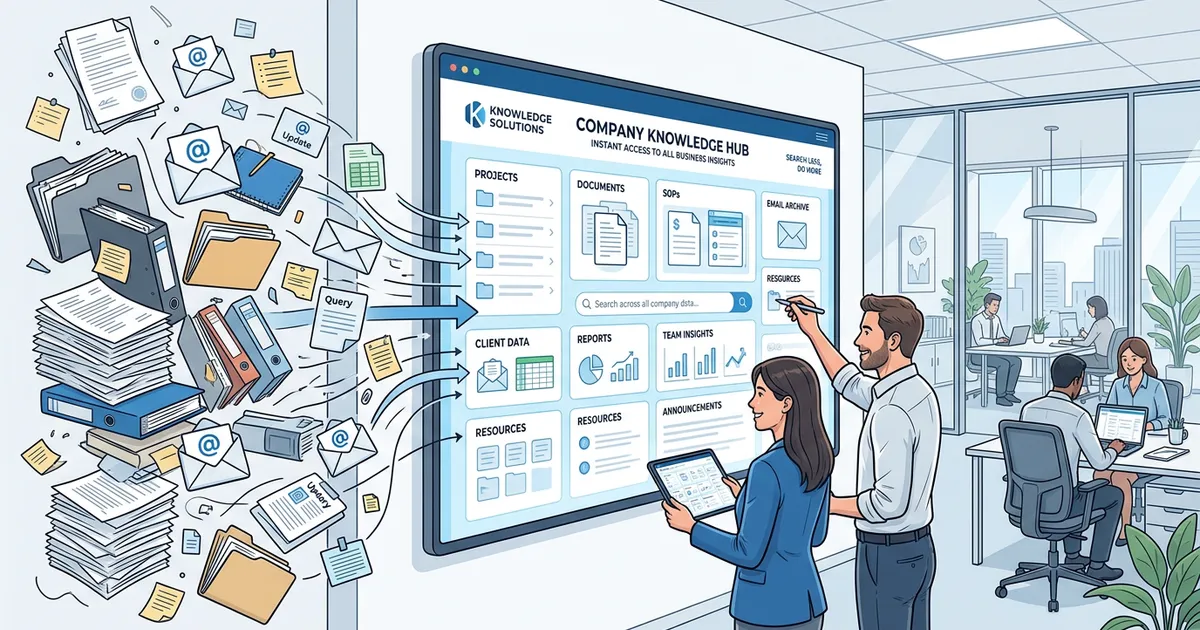
In many companies, knowledge is not missing. It is simply not available where it is needed.
Information is scattered across emails, PDFs, folders, systems, or in the heads of individual employees. The result: teams search, ask follow-up questions, and wait for answers even though the knowledge already exists.
Especially in SMEs, this quickly becomes a real problem. Service teams are slowed down, quotes get delayed, and internal workflows depend on individual people.
The real problem is not missing knowledge
Many companies believe they have too little documentation or need more alignment. In reality, something else is often missing: fast access to existing knowledge.
If information is not available at the right moment, the result is:
- follow-up questions
- search time
- waiting time
- duplicate work
- unnecessary dependencies
This does not just cost time. It directly affects service quality, response speed, and quotation processes.
Why this becomes expensive in daily operations
Distributed knowledge slows companies down at the same points again and again:
- Customer service answers the same questions repeatedly.
- Quotes take longer because information has to be gathered manually.
- Employees ask colleagues instead of accessing knowledge directly.
- Important workflows depend on individual people.
The knowledge exists. But it is not centrally usable.
What companies need instead
Companies do not need more information. They need usable company knowledge.
That means:
- finding knowledge faster
- reducing follow-up questions
- lowering search time
- delivering answers faster
- relieving service and sales
That is where a real competitive advantage lies today.
How LIVOI helps
LIVOI makes company knowledge usable in seconds.
Instead of manually searching for information, passing internal follow-up questions around, or relying on individual people, teams can access relevant knowledge faster.
This is especially valuable where speed matters:
- in service
- in sales
- with recurring follow-up questions
- in internal coordination
This turns distributed knowledge into a real lever for productivity, quality, and response speed.
Conclusion
Companies rarely fail because of missing knowledge. They fail because existing knowledge is not available fast enough. Anyone who improves that access relieves teams, accelerates processes, and creates more control in daily operations.
Would you like to identify where distributed knowledge is slowing your company down today and how LIVOI can concretely relieve your teams?