

 Start AI assessment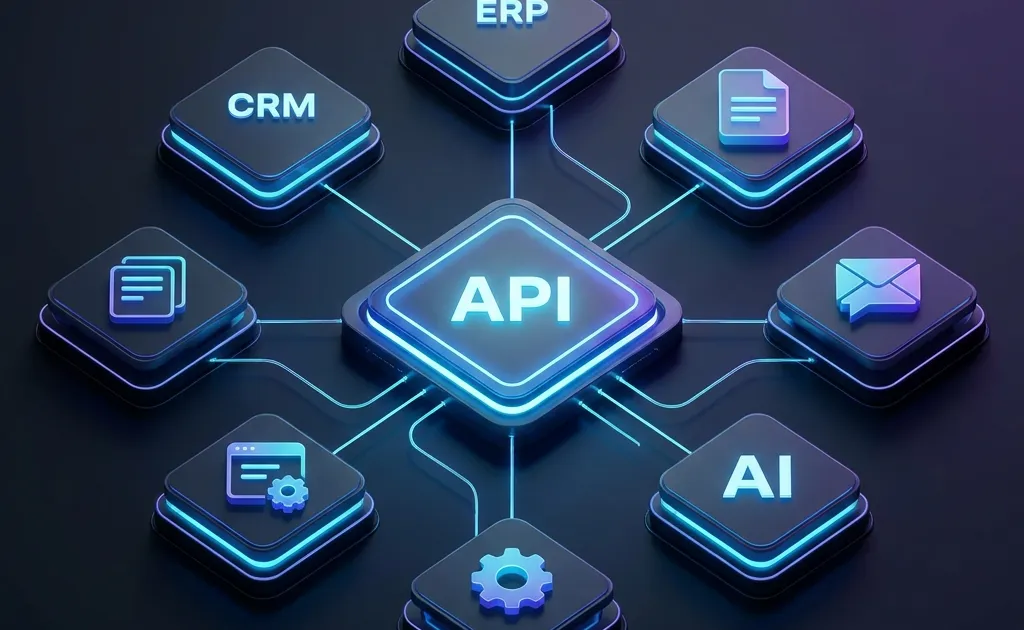
Many AI platforms claim to be flexible. In practice, that often means the UI was built first and the API was attached later.
LIVOI deliberately flips that model.
Not as a detail. Not as a technical extra. But as an architectural principle.
API-first is not a buzzword. It is a decision about the future
API-first does not mean there is also an interface. It means the API is the system.
Everything LIVOI can do is designed, modeled, and implemented through clearly defined endpoints. That is not a cosmetic difference. It changes how software is built, integrated, and scaled.
Many traditional systems start with the interface and only add integrations later. In an API-first model, the logic is defined first as a contract. The result is immediately tangible:
- no hidden capabilities
- no internal special cases
- no black box between the UI and the actual system behavior
What that means in practice at LIVOI
LIVOI is not merely “available through an API.” LIVOI exists as an API.
That means:
- every function can be used externally
- every automation can be reproduced
- every process can be controlled programmatically
There are no important features that only exist internally or can only be reached through a UI. What is possible can be documented, integrated, and called reliably.
That level of transparency matters in real companies. Once AI moves beyond experiments and becomes part of live operations, the key question is no longer which interface looks best. The key question is how cleanly the logic can be translated into the systems already in place.
Why this is a game changer for developers
In many traditional tools, developers are not fighting the actual problem. They are fighting the product itself:
- features exist in the frontend, but not in the API
- processes cannot be fully automated
- integrations turn into workarounds
API-first removes exactly that friction. A well-defined API becomes the stable foundation for everything built on top of it.
With LIVOI, that means:
- faster integration into existing systems
- clear contracts through documented interfaces
- parallel work without blockers between frontend, backend, and third-party systems
- full control over data flows and process logic
The system behaves deterministically instead of only behaving the way the current UI allows.
Why this matters even more for companies
API-first is not only a benefit for engineering teams. It is a strategic advantage.
It turns LIVOI into a platform instead of an isolated tool. That shows up most clearly in three areas.
1. Scalability without structural friction
If every function is designed around the API, the system can expand cleanly:
- to new channels
- to new agents
- to new processes
Without architectural rework. Without special-case logic. Without unnecessary technical debt.
That matters especially in more complex IT environments. Growth then happens on top of the existing structure instead of against it.
2. Integration instead of another silo
LIVOI is built to fit into existing systems instead of sitting beside them.
For example:
- CRM
- ERP
- DMS
- communication channels
Not as a loose add-on, but as an integrated part of the current system landscape.
That prevents the exact failure mode many digitalization projects run into: new silos, new media breaks, and new manual handovers.
3. Long-term flexibility
Technology changes fast. Architecture determines whether you can adapt or whether you have to start over.
API-first means:
- new frontends remain possible
- new AI models remain pluggable
- new use cases can be added
The API stays stable. Everything around it can evolve.
The most important point: control
Many AI systems look powerful as long as you never need to adapt them seriously. The moment you do, you often discover that you can use the system, but you do not really control it.
LIVOI reverses that relationship.
Through the API, every function becomes steerable:
- automations are explicit
- data flows are traceable
- decisions can be integrated into existing processes
The system is not just used. It is orchestrated.
Conclusion: API-first is not a detail. It is the foundation
LIVOI combines AI, automation, and knowledge in a platform that makes communication more structured and measurable.
But the real lever sits beneath that: the decision to think everything through the API from the start.
The result is not just another tool. It is a system that fits cleanly into existing processes while creating the foundation for new ones.
Put differently: Others build features. LIVOI builds interfaces that features can grow from.
You do not want to introduce just another AI solution. You want one that fits cleanly into your existing system landscape. We will show you how LIVOI is designed API-first for real integration, clear control, and an architecture that remains viable tomorrow.