

 Start AI assessment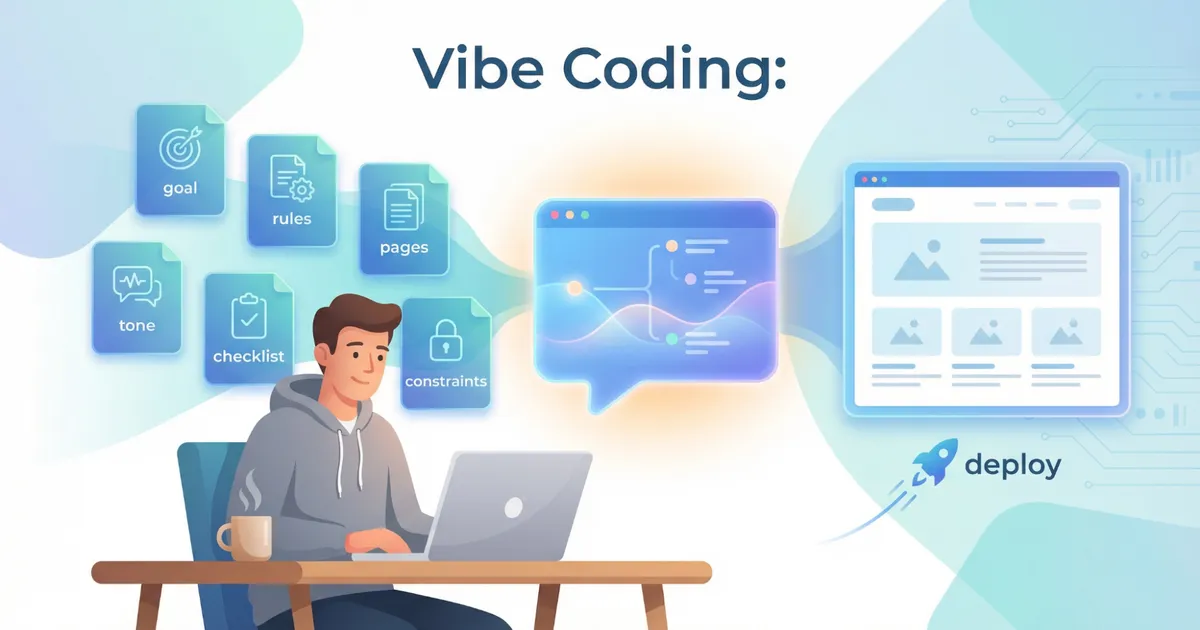
Software development is changing fundamentally. Not because programming suddenly became easy, but because the bottleneck is shifting.
In the past, the bottleneck was writing code. Today, the bottleneck is increasingly the ability to define context clearly.
We saw that very directly during the relaunch of our website. A project that would previously have looked like several months plus multiple feedback loops was built this time in a single weekend session, including a first working version and deployment.
The point is not that we are faster than everyone else. The point is that AI-assisted development turns web projects into a fundamentally different process.
The biggest practical takeaway is this: with vibe coding, you can now build software without traditional programming expertise if you are willing to define goals, rules, and context clearly.
What vibe coding means in practice
Vibe coding sounds like a buzzword, but in practice it is a very pragmatic way of working:
- You no longer write tasks for developers only.
- You define goals, rules, and context in a way that allows a model to derive working code from them.
- You iterate faster because the loop of ticket, waiting time, and implementation becomes much shorter.
This is not a replacement for engineering discipline. It is a different way of enforcing it: not through meetings, but through clear project rules and context documents.
Why this is so much faster than classic web projects
In traditional projects, time is spent not only on implementation, but also on translation:
- Business goal to concept
- Concept to requirements
- Requirements to design and components
- Components to code
- Changes to new tickets
AI shortens this chain dramatically because several translation steps collapse into one. But that only works if something else is in place: the context has to be machine-readable.
Context is architecture: the decisive lever
In AI-assisted development, context is not nice to have. It is the architecture.
We learned quickly that when context is scattered across chats, people, and notes, the model drifts. When context is bundled cleanly, it stays stable even as the project grows.
1. A global memory for the AI
A central documentation area, for example docs/ plus a clear project guide, should answer:
- What is the goal of the website?
- What page structure applies?
- Which design rules are fixed?
- Which tone and copy rules apply?
- What is explicitly forbidden?
That gives the AI something that would otherwise live in a developer’s head: orientation.
2. Structure over cleverness
We did not tell the AI to make it elegant. We told it to make it maintainable.
AI can become clever very quickly. That is exactly what makes projects expensive later. Structure beats magic.
3. Scaling through context maintenance
The project did not stay small. Even so, it remained controllable because updates did not happen informally, but through documents:
- Change a rule, update the document
- Output drifts, sharpen the context
- Add a new page, define the page template clearly
The real skill is not prompting. The real skill is versioning context cleanly.
What you can take away from this
The most important consequence of vibe coding is this: you do not have to be a traditional developer to build software today.
You do need to be able to describe a domain goal precisely, define rules, and provide structure.
If you can do that, software increasingly starts to emerge like a product conversation rather than a coding marathon. For mid-sized companies and small teams in particular, that opens up something that previously required large budgets: test fast, build fast, iterate fast.
Conclusion: the paradigm shift is real
The big change is not that AI writes code. The big change is that context becomes the key capability.
If you can describe domain goals precisely, define rules, and enforce structure, you can now execute projects that previously required multiple roles and weeks of work, at least within a scope like websites, landing pages, or content systems.
Our key takeaway from the relaunch weekend is simple: syntax is not the bottleneck anymore. Context is.
If you want to learn how to use AI meaningfully in your company and how vibe coding can help you create software prototypes without traditional programming expertise, send us a short message.