

You feel that your company should start doing something with AI, but you are not sure where to begin. This is how we approach the first step:
For many companies, AI is no longer just a trend topic. It is already here. In conversations, meetings, articles, customer appointments, and often quietly in everyday work.
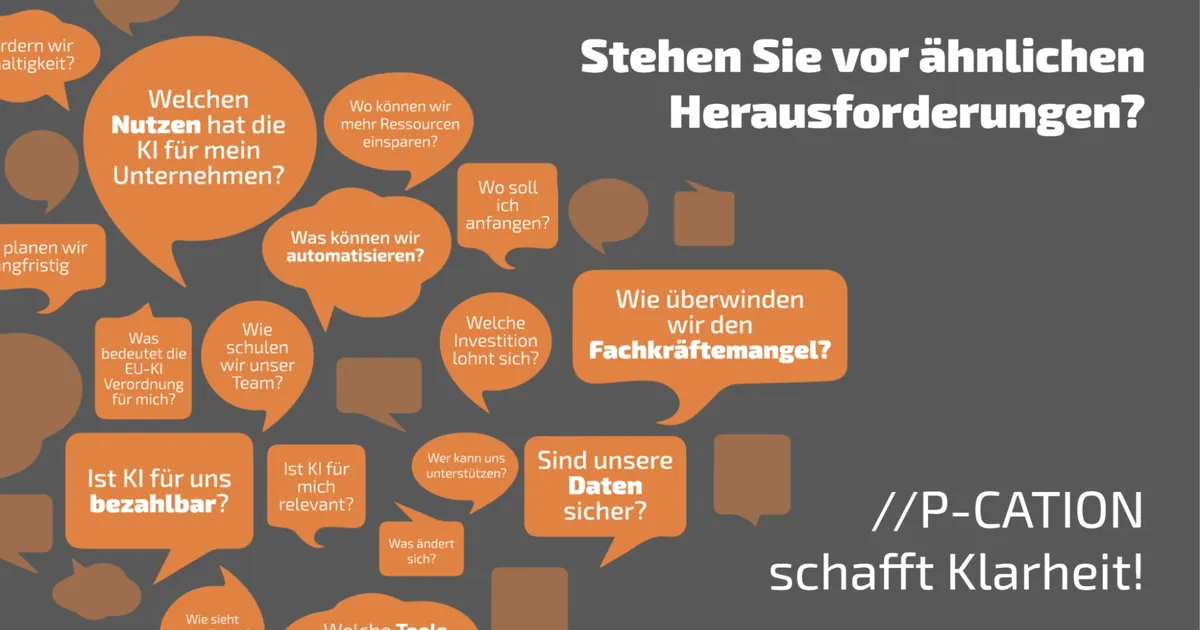
At the same time, the topic does not only create curiosity. It also creates unease. As attention grows, the next questions appear immediately:
- Where do we start?
- What will actually move us forward?
- Is it affordable?
- How secure is our data?
- And what does it mean for our team?
This is exactly where many companies get stuck. Not because they reject AI. Not because they are uninterested. More often, it is the feeling that an important decision has to be made before there is enough clarity.
A Situation Many Companies Recognize
In a mid-sized company, AI has already arrived in daily work. Not officially, not planned, and not clearly regulated. But it is there.
Some employees use ChatGPT for wording, first research, or summaries. Others try different tools because they hope to make their work easier. Others are unsure whether those tools should be used at all.
The managing director can feel it: AI has already reached the company. Just without a shared direction.
There is no clear line yet. No answer to which tools make sense, where the limits are, and how the company wants to handle the topic overall. Meanwhile, daily operations continue. Questions take time. Information has to be gathered. Processes drag on. Teams are already busy.
So it is actually quite clear that the company should deal with the topic. And still, it does not really get moving.
Not because nobody wants to. But because all the familiar questions immediately appear: What is truly useful for us? Where do we start without getting lost? How do we create orientation before everyone simply moves ahead alone? And how does a vague trend become a path that really fits the company?
What Is Really Missing in These Moments
At the beginning, technology is rarely the biggest problem. Usually, something else is missing: a clear view.
When too many topics are on the table at once, getting started becomes difficult. Costs, data protection, processes, team, responsibility, value, future. Everything seems important, and everything somehow depends on everything else. That is exactly how standstill happens.
That is why we do not start these situations with a finished solution. We first look at the company together.
- Where is time currently lost in daily work?
- Which tasks keep coming up again and again?
- Which workflows are unnecessarily difficult?
- Where would relief actually be noticeable?
- And where could AI realistically help?
This step alone often changes a lot. A large, confusing topic becomes something concrete. Suddenly it is no longer about “AI in general”, but about the company’s own reality.
When Unease Slowly Becomes Direction
Once this assessment exists, things often become much easier.
Not because every question is answered immediately. Not because everything is suddenly decided. The difference is somewhere else: the topic loses its fog.
It becomes visible where a sensible beginning could be. What really matters right now. What can wait. And what would actually help inside the company.
We see this again and again. At the start, many companies do not need even more input. They need a framework in which the right questions are sorted and uncertainty can turn back into orientation.
Conclusion
When companies hesitate on AI, it often has little to do with resistance. More often, there is something much more understandable behind it: responsibility.
People who make decisions for a company do not want to start just anywhere. They want to understand what fits, what makes sense, and which path is sustainable.
That is why a good start with AI rarely begins with a tool. It begins with clarity.
Would you like to calmly find out where AI could genuinely make sense in your company?
Then let us look at your questions, your situation, and the next sensible steps together in a first conversation.