

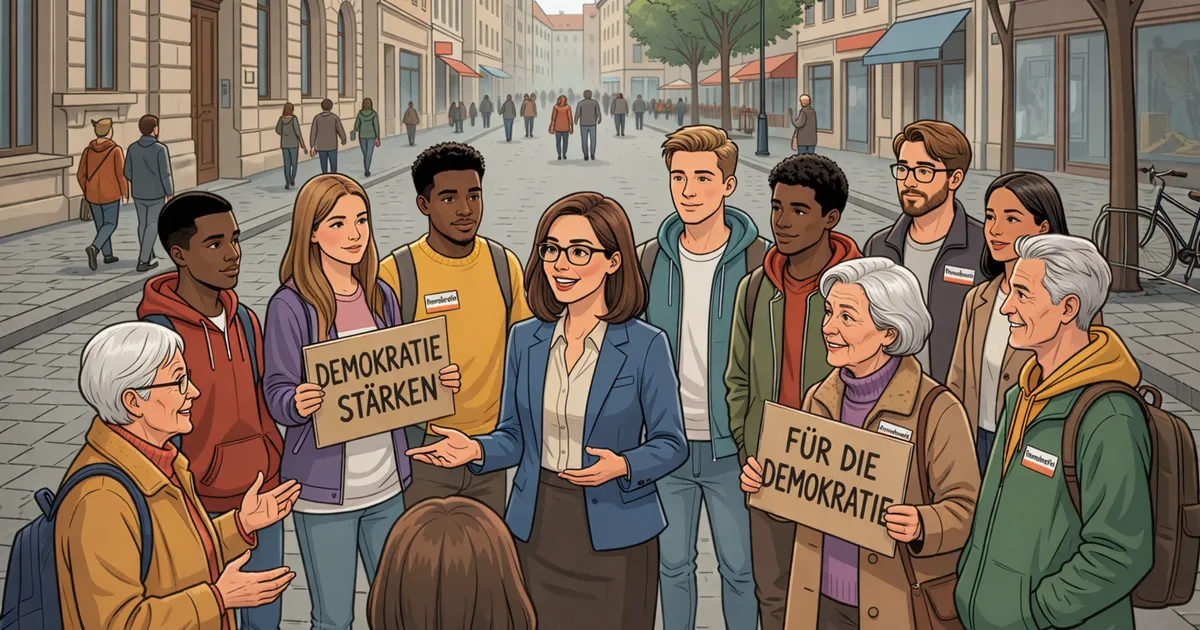
Democracy often does not fail because people lack interest. It fails because many people do not find an easy way into it.
Political processes can feel abstract, rigid, or unnecessarily complicated. Terms, responsibilities, and structures are often explained in ways that make people tune out instead of staying engaged. That is where the real problem begins: not everyone who keeps their distance is disillusioned with politics. Many people simply do not feel addressed.
When Civic Education Feels Too Far Away
Anyone who wants to understand how democracy works often ends up with long texts, formal explanations, or highly theoretical content. That may be factually correct, but it is not always helpful in everyday life.
Many people first want to know something else:
- How does this affect me at all?
- What is actually happening here in concrete terms?
- Where can I have a say without first having to dive deeply into a political system?
When these questions remain unanswered, distance grows. And distance can quickly turn into disinterest.
The Problem Is Not Democracy, but Access
Democracy depends on people understanding it, being able to place it in context, and experiencing it as something connected to their daily lives.
But when civic education feels dry, complicated, or preachy, it loses exactly the people it should be reaching.
This is what happens:
- Processes feel unnecessarily complicated.
- Participation feels far away.
- Civic education keeps its distance.
- People withdraw instead of getting involved.
Not because they do not care. But because the access point is missing.
This Is Where DemoRa Comes In
DemoRa was developed to make democracy more understandable, approachable, and accessible.
Not as political marketing. Not as voting advice. But as a fact-based, conversational access point to democratic topics.
The difference lies in the style:
DemoRa does not explain in a preachy way, but in a human way. Not complicated, but understandable. Not distant, but in a way that keeps people engaged.
The goal is not to overload people with information. The goal is to explain democracy so that it becomes easier to follow again.
DemoRa in Action
Someone wants to understand how democratic processes actually work. Maybe it is about a municipal decision, political participation, or simply the question of how to get involved in the first place.
The problem: There is plenty of information, but it feels too dry, too long, or too far removed from real life.
DemoRa creates a different kind of access.
The agent answers questions in language that remains understandable, puts connections into context, and makes civic education feel less like a lecture.
That creates not only information, but orientation.
Why This Matters Today
Democracy does not only need to exist. It also needs to be explained, understood, and experienced.
Especially at a time when many people are moving between information overload, uncertainty, and polarizing content, formats are needed that remain understandable without becoming superficial.
That is exactly DemoRa’s strength: an accessible, human, and fact-based way to bring democracy closer to people again.
Conclusion
For many people, democracy is not too complicated. It is often just explained in an unnecessarily complicated way.
DemoRa starts exactly there: with access, with language, and with the question of how civic education can become understandable and approachable again.
Would you like to experience how democracy can be communicated in an understandable, conversational, and fact-based way? Get to know DemoRa