

It starts quietly.
You are sitting in a meeting. At the same time, a system replies to messages, structures tasks, writes code snippets, and makes pre-decisions. Not because you are actively steering it, but because it keeps working.
That is exactly where things are changing right now. The new generation of AI agents is no longer just reactive. It is persistent, action-capable, and networked. Three projects currently show especially well what is technically possible: OpenClaw, Hermes, and Paperclip.
One important point: these systems are not direct competitors. They represent different layers of the same development. And they are not automatically designed for enterprise deployment.
TL;DR
OpenClaw, Hermes, and Paperclip show where agent systems are heading: persistent availability, learning-based improvement, and organizational control. For companies, the real value only starts when access, roles, approvals, and logging are properly governed.
- OpenClaw stands for always-on interaction inside real workflows.
- Hermes stands for memory, skills, and iterative learning.
- Paperclip stands for structure, roles, and control across multiple agents.
- Technically, this is impressive. Operationally, it is not automatically enterprise-ready.
- Companies should not start with maximum freedom. They should start with clear boundaries, ownership, and traceable control.
What defines an agent today
In this article, we mean systems that are continuously available, can perform actions, and operate where people already work.
That combination creates productivity. That same combination becomes a business risk when governance is missing.
Three systems, three layers
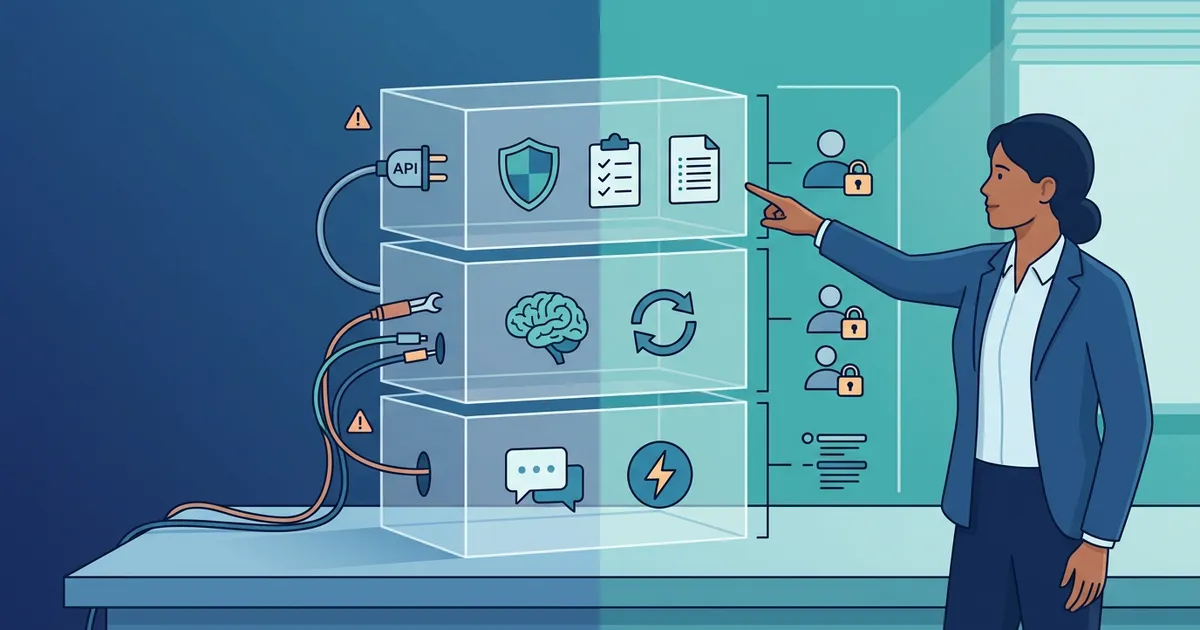
You can read the development like a stack.
OpenClaw stands for interaction and availability.
Hermes stands for learning and improvement.
Paperclip stands for structure and control.
The decisive question is not which tool wins. The decisive question is which layer you actually need and how you can run it safely.
OpenClaw: The agent that is always available
OpenClaw feels like the step from a tool to infrastructure. The agent lives where communication happens. You do not start it. It is already there. You write. It works.
Technically, this is roughly based on a messaging gateway with persistent sessions and tool or skill integrations. That means the agent can do more than reply. It can complete tasks and stay inside context.
What makes it interesting is the day-to-day feeling: a digital colleague moving along inside the workflow.
For companies, that is exactly the critical point. Always-on plus tool access means the agent becomes part of the system landscape. From that moment on, the same questions apply as for any production-critical component:
- Who is allowed to configure it?
- Which actions are allowed?
- What needs approval?
- What is logged in a traceable way?
Hermes: The agent that improves itself
Hermes goes one layer deeper. This is no longer just about availability. It is about development. The agent is supposed to improve over time, including through memory, skills, and learning loops.
In simple terms, Hermes stores experience, expands capabilities, and works within guardrails so that its behavior still develops in a useful direction.
That is exciting because Hermes is not static. The system grows, similar to an employee who gets better the longer they stay in the team.
For companies, that is also the challenge. Once a system learns, its behavior changes. That makes governance harder: predictability, auditability, and quality over time all have to be actively ensured.
Paperclip: The organization behind the agents
Paperclip is not an agent in the classic sense. It is a layer above that. It acts as a control plane for agent work.
The idea is simple: once multiple agents are working, management becomes necessary.
That is exactly where Paperclip starts. Roles, teams, task structures, approvals, budget limits, and auditability are its core. It addresses a problem many organizations only notice when it is already too late: agents can create chaos when nobody governs who may do what and how decisions remain traceable.
Still, a control plane does not solve everything automatically. Execution still happens inside connected agents and tools. Trust, access, and the security model still need to be clarified properly.
What is emerging here is a stack - but not yet an enterprise standard
Taken together, OpenClaw, Hermes, and Paperclip show a direction: agents become persistent, more dynamic, and increasingly in need of control.
That answers the demo question. It does not yet answer the operations question.
How do you run this safely inside a company?
Why these systems can be risky for companies
These platforms are impressive. They show what is technically possible. But that is exactly the point: they are primarily exploratory and developer-driven. For companies, that creates concrete risks.
High system access
Agents can execute code, call APIs, and modify data. Full access conflicts with the least-privilege principle. As soon as an agent can do too much, assistance turns into risk.
Missing clear roles and permissions
Many systems assume a simple trust model: one user, one agent, one context. Companies need differentiated permissions, departmental logic, approvals, and standards.
Unclear liability and ownership
If an agent influences decisions or executes actions, the question becomes who is responsible. In open systems, that question is not always central. In companies, it is unavoidable.
Dynamic behavior
Especially with learning systems, behavior changes over time. Outputs are not deterministic, quality becomes harder to audit, and without monitoring and testing a system can drift before anyone notices early enough.
Integration into the IT landscape
Companies need API control, identity and access management, logging, monitoring, and compliance. Many agent systems are not primarily built for that, because they come from a developer-first world.
How companies should proceed pragmatically
If you want to move beyond experimentation, do not start with an agent that can do everything. A staged rollout is the better approach.
- Start by narrowing the use case
Not “we need agents” but, for example, “we want to pre-sort inquiries” or “make internal knowledge easier to access.” - Define permissions and roles before features
Who may only read, who may write, who may approve, and who owns the outcome? - Strictly limit tool and API access
Every integration should have a clear purpose, not blanket full access. - Build in logging, audit trails, and approvals
A company must be able to understand what an agent did, on what basis, and with which result. - Keep human control as the final instance
Especially for sensitive decisions, the agent should prepare, not decide alone. - Start with a pilot and monitoring
Quality, failure modes, and drift should be measured from day one.
That is exactly where LIVOI differs
LIVOI is not an alternative to OpenClaw, Hermes, or Paperclip in the sense of “same category, different vendor.” It is a different category.
While those systems show what is technically possible, LIVOI focuses on what can be operated sensibly and safely inside a company: B2B-first architecture, clear roles and responsibilities, controlled data access, API-first integration, and human control as the final instance. The core is data ownership, governance, and traceability.
In short: less freedom, more reliability.
If you want to see how that controlled operating model is implemented in practice, our LIVOI page gives the key overview of use cases, security posture, and rollout model.
FAQ
Are OpenClaw, Hermes, and Paperclip fundamentally unsuitable for companies?
No. They are important technology pioneers. The issue is not the idea, but the operating model. For productive enterprise use, security, roles, approvals, and traceability have to be much stronger than in many exploratory setups.
Which layer does a company need first?
That depends on the goal. If the aim is to reduce communication load, the interaction layer comes first. If the aim is to work with agents on an ongoing basis, governance, permissions, and approvals become essential as well. That is exactly why technology alone is rarely enough.
Is a control plane like Paperclip enough on its own?
No. A control plane helps with structure and oversight, but it does not replace the security model of the connected agents, data sources, and tools.
Conclusion
OpenClaw, Hermes, and Paperclip are important projects. They show how AI can work, learn, and be organized. They are technological pioneers.
The next step is operationalization inside companies. That is where a new market is emerging: less experimentation, more control, and more reliability.
The real question is no longer whether AI can do this. The real question is how to use AI without losing control. That is what decides whether AI remains a toy or becomes a productivity factor.
If you want to approach AI adoption in your company in a practical and controlled way and find out which agent layer actually makes sense for you, a short introductory call is worthwhile. Together, we can look at where LIVOI agents can create real impact in your business and which guardrails are required.