

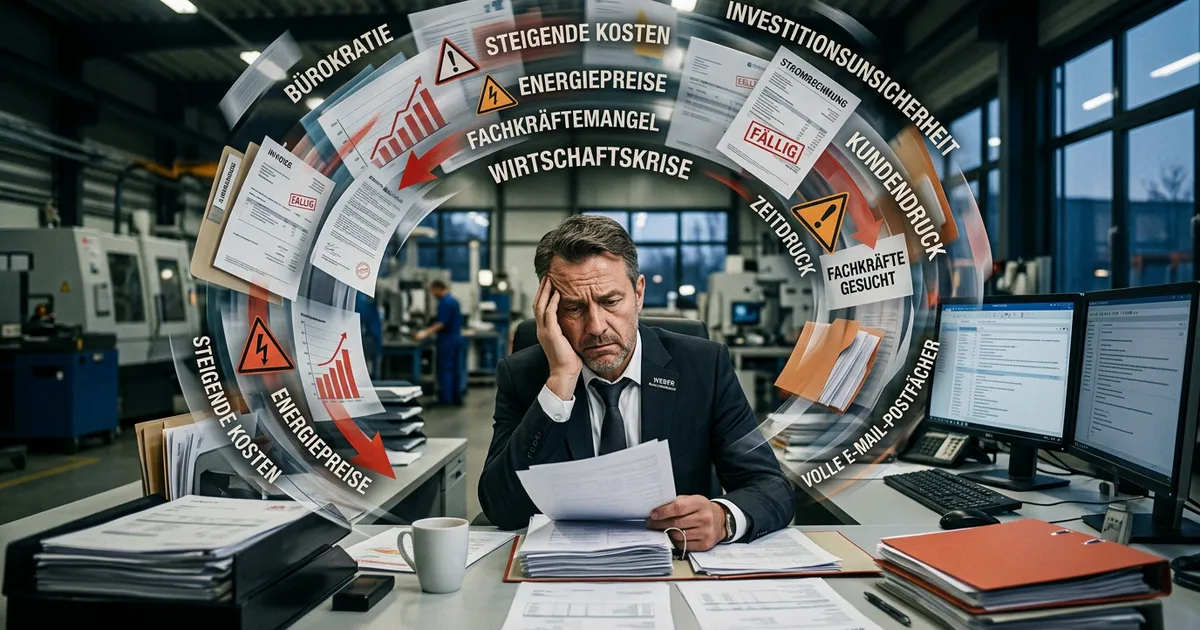
The phoenix interview with Christoph Ahlhaus, chairman of the federal executive management of Der Mittelstand. BVMW e. V., makes a mood visible that many mid-market companies know well: pressure keeps rising, while real relief hardly reaches daily operations.
Ahlhaus is not describing an isolated case. He points to a state that many entrepreneurs feel directly: they are expected to invest, protect jobs, serve customers reliably, and at the same time deal with rising costs, bureaucracy, and political uncertainty.
In a tense economic environment, that leads to caution. Investments are postponed or reviewed much more critically. This also affects artificial intelligence. Many companies know that AI will matter, but they do not yet have a clear view of where to start, what is actually worthwhile, and how much effort will be involved.
That uncertainty is one of the key issues. The mid-market is not fundamentally against change. Companies simply do not want to take on additional risk when value, effort, and outcome remain unclear.
What the Interview Shows About SME Pain Points
The first major pain point is a loss of trust in political promises. When relief is announced but hardly felt in daily operations, frustration grows. Companies need reliability, especially when they are expected to invest.
The second point is missing planning security. When companies do not know which costs, rules, or burdens will come next, they decide more cautiously. That slows investment, digitalization, and modernization.
Third, bureaucracy weighs on daily work. Documentation duties, evidence requirements, internal coordination, and recurring follow-up questions consume time. For many mid-market companies, this is especially hard because they do not have large administrative departments.
The fourth point is cost pressure. Energy, levies, wages, and general operating costs are rising. At the same time, customers expect fast answers, good availability, and professional communication.
This creates a clear tension: SMEs are expected to become more productive, but they have less room to maneuver. That is exactly why companies need to examine where they can create relief themselves.
Where LIVOI Comes In
LIVOI does not solve political problems. The AI communication assistant does not reduce energy prices or change legal requirements. It starts where companies have direct influence: inside their own day-to-day work.
In many organizations, friction appears every day through recurring questions, incomplete requests, scattered knowledge, and long search times. Each individual situation may look small. In total, it costs working time, attention, and money.
LIVOI makes company knowledge usable. The assistant answers recurring questions, captures requests in a structured way, and prepares information. As a result, employees are not interrupted for every standard question.
The goal is not to replace people. The goal is to protect their time. Employees should be able to focus more on work where experience, judgment, and personal communication truly matter.
Why the Entry Point Needs Guidance
In a difficult environment, concern about poor investments is justified. That is why P-CATION does not start with a rushed implementation, but with a structured clarification phase.
In the AI starting-point check, we examine where LIVOI can actually make sense inside the company. The questions are concrete: Where do recurring requests appear? Where do employees regularly search for information? Which processes bind unnecessary time? Where can relief become measurable?
Workshops help employees understand the use case. AI should not be perceived as an additional burden, but as support in everyday work. To achieve that, concerns, questions, and concrete usage situations need to be taken seriously.
Support does not end after rollout. Through monthly feedback discussions and individual optimizations, LIVOI is adapted to actual usage. Content, workflows, and answer behavior can be improved over time so the solution becomes better in daily operations.
Why LIVOI Can Pay Off Even in Difficult Times
The return on investment does not only come from new revenue. It mainly comes from saved working time, fewer follow-up questions, faster communication, and more accessible knowledge.
Especially when costs rise and teams are stretched, every saved hour becomes more valuable. LIVOI can help companies use existing capacity better and reduce recurring communication work.
That turns AI from a risky future project into a practical tool for operational relief.
Conclusion
The interview with Christoph Ahlhaus shows the pressure that SMEs are facing: high costs, bureaucracy, uncertainty, and investment restraint.
With LIVOI, P-CATION does not start with the political framework. It starts where companies can act themselves: communication, knowledge, and recurring tasks.
LIVOI shows how relief in the mid-market can begin in practical terms.
Initial LIVOI Consultation
Would you like to find out whether LIVOI can be used meaningfully in your company?
In a non-binding initial conversation, we look together at where recurring questions, search effort, or unstructured requests are tying up time.