

An employee retires. With her goes the answer to why a particular customer received a special discount three years ago. Nobody documented it anywhere. It simply lived in her head.
That is the problem very few companies have on their radar. It is not a lack of data. It is knowledge that disappears as soon as the person who held it is no longer there.
Stored Is Not the Same as Available
Documents sit in folders. Messages remain in inboxes. Project data lives in different systems. At first glance, this looks like a complete archive.
But a folder full of files does not know how things are connected. And that is precisely the difference between an archive and a memory.
Almost Every Company Knows These Situations
A new employee asks a question that has already been answered somewhere in the company. A decision exists, but no one remembers why it was made. A file is called “Proposal_final_v3,” and nobody can say whether it is actually final.
The information is usually still there. It is simply scattered across emails, chats, folders, and the minds of individual colleagues.
A File Does Not Know Its Own Meaning
A document contains a title, a date, and some content. What it does not know on its own is which customer it belongs to, which decision was based on it, or whether a newer version has already replaced it.
For day-to-day work, these connections are exactly what matter. People searching for knowledge rarely want to find “a file.” The real question is: What do we know about this topic, and what does it mean for my current task?
Knowledge That Exists Only in People’s Heads Is a Risk
The shortage of skilled workers affects almost every SME. When knowledge is also tied to individual people, every illness, vacation, and resignation becomes a risk. New employees take longer to get up to speed. Teams solve the same problems more than once because previous insights are not visible anywhere.
This has nothing to do with the performance of individual employees. It is simply because their knowledge exists nowhere else but in their own minds.
What a Corporate Memory Does Differently
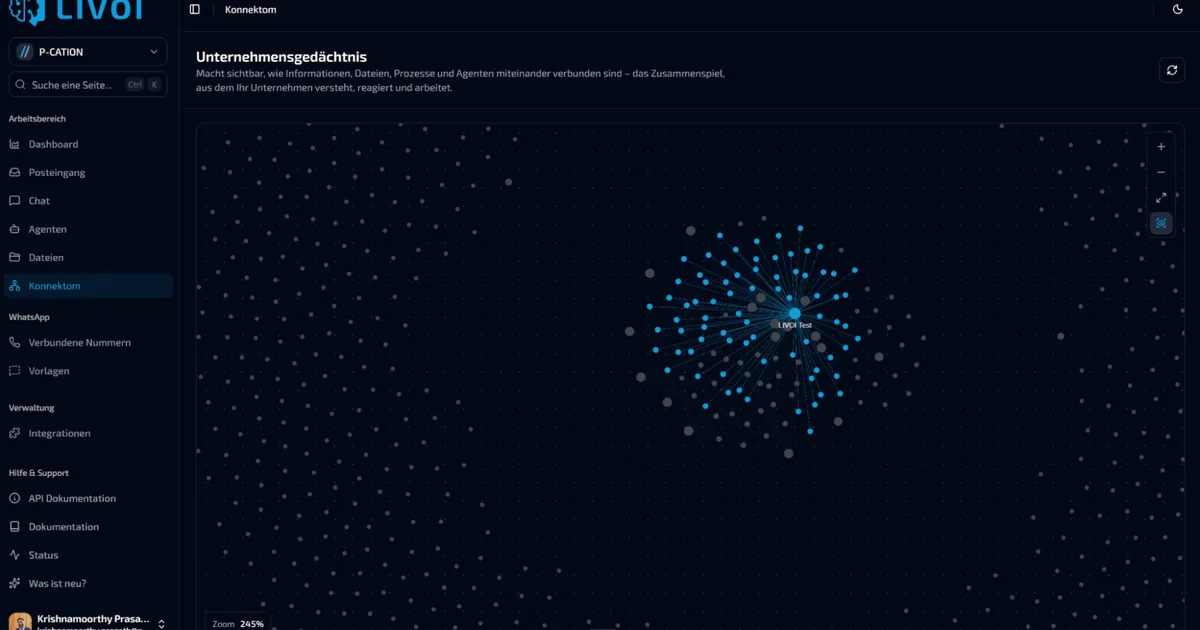
This is exactly where LIVOI comes in. Instead of merely storing documents, LIVOI makes the connections between information, files, processes, and contacts visible. A customer request points to the relevant project, the associated document, and the decision that was made at the time. A later request can access that context directly.
This turns a collection of individual files into a network that shows what belongs together and where an answer came from.
Not a Replacement, but a Backbone
A corporate memory does not replace experienced employees. It ensures that their knowledge does not walk out the door with them. Professional judgment and experience remain with people. LIVOI simply makes accessible what would otherwise be lost.
And because every answer can be traced back to its original source, it is always clear what that answer is based on. Control is part of this as well: access rights, hosting in Germany, and GDPR-compliant operation are built into LIVOI from the start, not added as an afterthought.
You can learn more about its use cases, security model, and implementation on the LIVOI product page.
What This Means in Practice
At VB Airsuspension, this exact approach reduced the onboarding time for new employees by 50 percent. Not because they asked fewer questions, but because the answers were immediately available—with sources and context.
A company does not become more intelligent by collecting more data. It becomes more intelligent when it remembers.
Find Out Where Your Company Is Losing Knowledge
In the potential analysis, we look together at where knowledge in your company is tied to individual people and where a corporate memory like LIVOI can make the greatest difference. The assessment is specific to your business and provides clear next steps.