

Several years ago, Thierry Breton, then CEO of IT services provider Atos, announced that his company would become completely email-free. The reason was simple. Each of the company’s 80,000 employees received more than 100 emails per day on average. By the company’s own estimate, only about one in seven was useful.
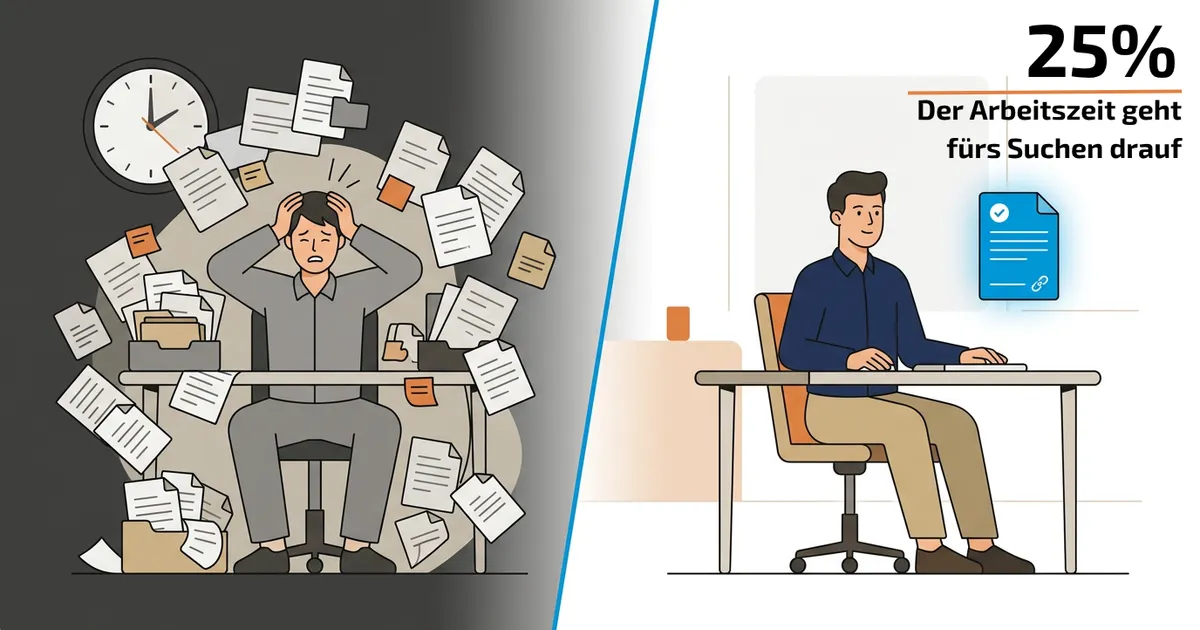
The second figure Atos reported at the time was even more revealing. Email was not the real problem. Searching was. A quarter of working time was spent looking for information or the right person to ask.
The underlying McKinsey study is more than ten years old. Since then, the problem has probably become more severe rather than less, with more documents, more tools, and more knowledge scattered somewhere between a shared drive, an inbox, and a colleague’s head. McKinsey broke down knowledge workers’ time as follows: 28 percent on email, 19 percent searching for information, and 14 percent on internal communication and collaboration. Together, that is more than half of the working week.
Why nobody notices
No controller records this lost time. There is no cost center for searching. It is spread across a hundred small moments each day, which is precisely why nobody treats it as a problem.
In practice, it often looks like this. The bill of materials for an older component is stored in a spreadsheet from 2019 on a drive that hardly anyone opens anymore. The answer to a customer question is known by the colleague who has been on vacation since last week. A new employee asks around because no document even explains where to start looking.
So people ask, wait, or continue searching. Sometimes a solution is simply rebuilt even though the company created it once before.
The flawed assumption: more filing instead of less searching
The typical response to this problem is more structure. A new filing system, a thicker manual, another onboarding document. The problem is that all of this makes searching easier. It does not make searching unnecessary.
This is where the real leverage identified by the McKinsey study lies. Better access to internal knowledge can reduce search time by up to 35 percent. Not through more documentation, but through more direct access at the moment a question arises. The goal is not to write down even more. It is to make the right answer immediately available, regardless of where it was originally stored.
When knowledge answers instead of waiting
This is exactly where LIVOI comes in. It is not a system that generates something merely plausible. It answers exclusively from a company’s approved documents and provides a source for every response. Anyone who wants to verify a statement can return to the original document with one click.
For the business, that means no disruption to existing processes and no months-long implementation. Getting started takes two days, not weeks. It is a fixed package with a clear outcome from the beginning, not an open-ended IT project.
And there is one point that matters to many business owners: LIVOI does not replace skilled employees. It ensures that knowledge is no longer tied to one person, whether that person is on vacation, in another department, or long since retired.
Evidence from the real world
VB Airsuspension recognized this pattern in its own business. New employees needed weeks to find their way around because much of the relevant knowledge existed only in the heads of experienced colleagues.
With LIVOI as a knowledge colleague, that knowledge became accessible directly from the company’s existing documents. The result: 50 percent less onboarding time. Not because less was explained, but because nobody had to wait until the right colleague was available.
What this means for your business
There is a good chance that this pattern also exists in your company, only unmeasured. A potential analysis shows exactly where knowledge is being lost and where the greatest leverage lies in your business, not as a general theory.