

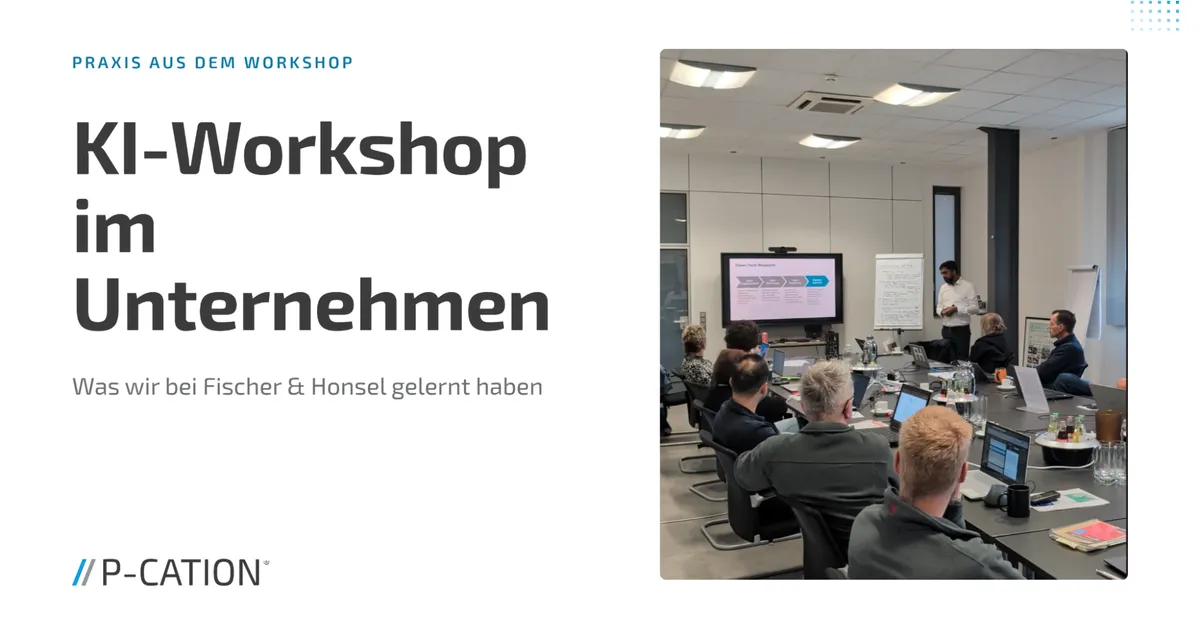
An AI workshop at work is most useful when it includes everyone, not just the technology enthusiasts. Our workshop at Fischer & Honsel in Arnsberg confirmed that once again. Fifteen employees came together, ranging from people encountering AI for the first time to daily users.
Many business leaders know the situation: the decision to use AI has been made, and licences may already be available. Yet little changes in everyday work. Some people experiment quietly on their own, while others keep their distance. A company email or an explainer video rarely changes that.
The workshop at Fischer & Honsel
Fischer & Honsel is a lighting manufacturer based in Arnsberg. We visited the company in person for the workshop. The group was deliberately mixed: 15 employees with very different levels of experience.
We kept the structure simple. A short introduction covered what AI can and cannot do. Then everyone worked on tasks from their own day-to-day work. We moved between participants and helped wherever someone got stuck.
From complete beginner to expert: everyone in one room
Before these sessions, we often hear the same concern: the group is too varied. Some people will be bored, while others will struggle to keep up. At Fischer & Honsel, the opposite happened.
People who had never worked with AI could try the basics at their own pace and quickly see their first results. Those with experience went further and tested their own workflows. Both groups took something away from the day.
That is what distinguishes a practical AI workshop from lecture-style training. There is no single pace. Everyone works at their own level, using their own tasks.
Trying things and asking your own questions
A talk explains what AI can do. A workshop demonstrates it using your own situation. That is the real benefit: employees work with familiar tasks, such as an email, a summary or a piece of research.
This raises questions that no presentation anticipates. How do I handle this specific case? Am I allowed to enter this data? Why does my result look different from my colleague’s? A workshop lets us answer these questions immediately, often right at the person’s screen.
A typical example: someone in internal sales handles similar customer enquiries every day. During the workshop, they ask AI to draft a response, check it and adjust the tone and details. The first attempt is not quite right. After two or three adjustments to the instructions, the draft fits. That immediately raises the next questions: how can I use this in everyday work, and which customer data may I enter? We address both on the spot.
Concerns come into the open and become easier to address
Almost every discussion of AI carries an unspoken question: what does this mean for my job? As long as that question remains unanswered, people remain hesitant.
A workshop makes the issue concrete. Someone who sees AI take over a tedious routine task, while still needing to check the result, quickly understands its role as a tool. Expertise, judgement and responsibility remain with people.
We have held this position for a long time. We have supported companies through change since 2014 and have never viewed AI as a way to cut jobs. AI is a tool for people who want to do their work well. In a workshop, participants experience that directly.
What business leaders gain
For management, a workshop is the most direct way to put AI into employees’ hands: an opportunity to try it themselves.
The effect appears in two areas. First, people use AI better. Knowing how to write useful instructions and check results improves output and reduces mistakes, providing practical relief in daily work. Second, the barrier to getting started falls. People who have tried something successfully continue using AI and suggest their own ideas for where it could help the company.
There is also a legal aspect. Since February 2025, Article 4 of the EU AI Act has required providers and deployers of AI systems to take measures to ensure sufficient AI literacy among their staff. In-house training can contribute to meeting that obligation.
What makes a good company AI workshop
We took three lessons from Fischer & Honsel. A good workshop uses the team’s own tasks rather than examples from unrelated industries. It leaves room for individual questions and provides enough support to keep everyone involved. And it is honest about where AI helps and where it does not.
With 15 participants, the group was large enough for different perspectives and small enough for every question to have its place.
If you are considering introducing AI more widely across your company, a workshop is a good first step. Find out how we structure them on our AI workshops page.
An AI workshop for your team
Would you like a workshop tailored to your company and employees? Book a meeting with us. Together, we will look at where your team stands today and what an individual workshop could look like for you.