

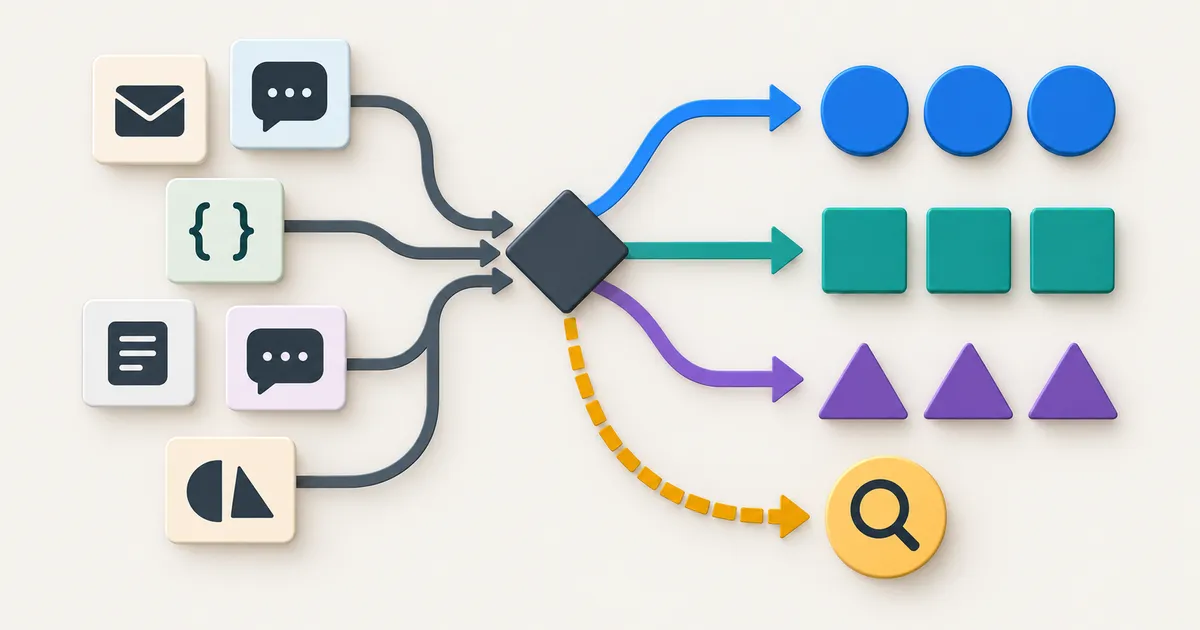
A shared inbox receives a new message. Before anyone writes a reply, several smaller decisions need to happen: what is the customer asking for, which team should handle it, and does it need attention today?
That is the kind of work Jev from TypeSafe AI is designed for. Introduced on 15 September 2026, it is the company’s first public System One model. TypeSafe describes a new architecture, parallel sampling and training called Reinforcement Learning for Calibrated Decisions, or RLCD. The aim is to make structured decisions directly usable by software. TypeSafe’s launch announcement explains the approach.
Information checked on 22 September 2026. Performance figures below are provider claims; we have not independently benchmarked Jev.
TL;DR
- Jev fits narrowly defined classification, routing and scoring tasks inside applications.
- A valid output format still leaves room for a wrong decision.
- The useful business question is which repeated decisions can become cheap and quick enough to automate.
- Test the complete workflow, including uncertain cases, before handing it responsibility.
What does “System One” mean?
The name borrows from Daniel Kahneman’s distinction between quick, intuitive judgment and slower, deliberate reasoning. In TypeSafe’s implementation, you supply relevant information and bounded questions. The model returns decisions instead of drafting prose. It currently accepts text and structured text data, with no native image, audio or video input. The System One documentation describes this boundary.
Think of a sorting step in an application. “Does this message ask to change a delivery address?” is a useful candidate. “Resolve this customer dispute, weighing our entire relationship with them” needs a much broader process.
Classification itself is well established. What deserves attention here is the attempt to make these small judgments a practical building block that developers can call repeatedly, even in interactive software.
What actually comes back?
Jev exposes three question types. These examples illustrate how a company could define them:
| Question type | Example | Result |
|---|---|---|
| Choice | Which inbox should receive this request: sales, service or other? | One allowed option, probabilities across the options and confidence. |
| Score | How urgent is the message under our defined urgency criteria? | A rating on described, ordered levels, with probabilities and confidence. |
| Noul | Does the customer explicitly ask for a callback? | A probability between 0 and 1 that the answer is yes. |
The official references explain Choice, Score and Noul. Noul does not have a separate confidence field.
Several independent questions can share one request and be evaluated in parallel. Their results are combined by the surrounding application. If one question needs another answer first, the application must handle that dependency. TypeSafe’s introduction explains this composition.
For an inbox workflow, we would define the allowed teams, give each a clear description and include an “other” route. That last option matters: a request about an unexpected topic should have somewhere to go.
Type safety does not guarantee the right answer
Suppose your software only accepts sales, service or other. Returning an allowed value solves the format problem. Returning sales for a complaint still sends the work to the wrong place.
This is the distinction to keep in mind when reading claims about eliminating hallucinations. A constrained answer space prevents invented output categories; it does not prove that a classification matches reality. Nor does a stable format establish that repeated calls always choose the same answer.
Our recommendation is to measure two things separately: whether an answer can be processed, and whether it leads to the right business outcome. A technically successful API call can still create rework for your team.
How to use probability and confidence
For Choice and Score, TypeSafe’s confidence summarizes how concentrated the returned probability distribution is. It is different from the probability of one option. A confidence of 0.9 should therefore not be read as a promise that this individual answer is 90% correct. The confidence documentation explains the distinction.
In our inbox example, start by running the classifier alongside staff decisions. Then examine which kinds of messages it handles well and where it is confidently wrong. Set routing thresholds from those observations.
The threshold for adding a removable topic label can differ from the threshold for escalating an urgent complaint. A weak or ambiguous result should leave a case available for review. The original message remains the record; the classification is an additional interpretation.
Why the speed and price matter
TypeSafe advertises roughly 194 times faster and 445 times cheaper results in its workflow evaluations. Its launch post explicitly describes those gains as being toward the upper end of what it expects in practice. These are workload-specific comparisons. Launch figures and caveats.
The evaluation methodology uses four workflows and reference answers derived from other large models. Agreement with those references is useful evidence, but it is not independent proof of correctness on your company’s data.
The listed price for Jev 1.13 is $0.042 per million input tokens, with output tokens free. Current model reference.
For illustration: 100,000 requests with 1,000 billed input tokens each would cost $4.20 in model input charges at that rate. That is our arithmetic example, not a project quote. Instructions and questions contribute to input, and integration, retries and review also cost money.
This changes which tasks are worth trying. A business may want an inexpensive first pass over every incoming request, then reserve more capable reasoning and human attention for the smaller set that needs it.
Where we would start—and where we would not
Good pilot candidates include assigning incoming requests to teams, tagging customer feedback by topic and sorting an existing text archive into predefined categories. Each offers a result that staff can inspect and correct.
We would be more cautious with broad quality judgments such as “Which of these complex implementations is best?” A narrow check against an explicit criterion can help an evaluation process. It does not establish overall correctness.
The same applies to context compaction in an AI assistant. Selecting apparently relevant messages and producing a coherent summary are different tasks. Deleting history can remove dependencies that only become important later. A fast filtering demonstration does not establish that an assistant will perform better afterward.
TypeSafe itself documents weaknesses in arithmetic, date comparisons, indirect reasoning and large inputs full of irrelevant detail. Calculations and exact comparisons belong in ordinary code. Known Jev 1.13 limitations.
There are also concrete input limits: the current model allows 64k tokens per request, with 32k for the state plus the longest question. English is its strongest documented language; German workloads need their own evaluation. Model limits and language support.
What this means for companies
Our view is that useful AI workflows will increasingly combine several kinds of tools: ordinary code for exact rules, a classifier for bounded interpretation, a generative model for drafting or deeper reasoning, and people for exceptions.
The first step is to identify a repeated decision with clear outcomes. Gather representative examples, agree on the correct labels and measure both mistakes and time saved. Expand only when the results justify it.
That process perspective also guides our work with LIVOI. A model becomes useful when it fits the information, responsibilities and software around it. This article describes a possible architectural role for Jev; it is not an announcement of a released LIVOI integration.
Common questions
Can Jev replace a writing or coding assistant?
It is designed for bounded decisions. Use a generative model when the task requires new prose, code or a synthesized explanation. Jev can support a smaller decision within that workflow.
Does type-safe mean error-free?
It means the output respects its type constraints. The selected answer can still be wrong, and the application still needs error handling and review paths.
What should we test first?
A reversible task, such as suggested inbox labels. Compare its decisions with staff judgments on real examples before enabling automatic routing.